If you run a small business in the UK and have heard the term micro entity accounts but are not quite sure what it means, you are in the right place. In simple terms, micro entity accounts are a shorter and simpler version of annual accounts that very small companies can file with Companies House instead of full statutory accounts.
They were introduced to reduce the reporting burden on the smallest businesses, so if your company qualifies, you can save a lot of time and paperwork every year.
What Are Micro Entity Accounts?
Micro entity accounts are a set of simplified financial statements that eligible small companies in the UK can submit to Companies House. They were introduced under the Companies Act 2006, as amended by the Small Business, Enterprise and Employment Act 2015, to give very small businesses a lighter touch option when it comes to annual reporting.
Unlike full statutory accounts, micro entity accounts do not need to include a profit and loss account or a directors’ report on the public register. You only need to file a very basic balance sheet, and even that only needs to contain limited information. This makes the whole process far quicker and less stressful for small business owners who may not have a dedicated finance team.
It is worth noting that although you file simplified accounts with Companies House, you still need to prepare full accounts for HMRC when submitting your Corporation Tax return. Micro entity accounts are specifically for the public filing requirement, not your tax return.
Quick summary: Micro entity accounts are simplified annual accounts for very small UK companies. They reduce the information you need to put on the public record at Companies House, saving you time and keeping sensitive financial details more private.

What Qualifies as a Microbusiness?
To file micro entity accounts, your company must meet at least two out of three of the following conditions for two consecutive financial years:
- Annual turnover of no more than £1M
- A balance sheet total of no more than £500,000
- No more than 10 employees on average during the financial year
If your company meets these thresholds for two years in a row, you are eligible to use the micro entity regime. You only need to satisfy two out of the three conditions, not all three.
Are There Any Companies That Cannot Use Micro Entity Accounts?
Yes, even if your company meets the size thresholds above, some types of businesses are excluded from the micro entity regime. These include:
- Public companies (PLCs)
- Companies that are part of a group (unless the whole group qualifies)
- Charities
- Companies regulated under financial services legislation
- Investment undertakings and financial holding companies
If your company falls into any of these categories, you will need to file under the small, medium, or large company regime instead, depending on your size.
What is the Turnover Limit for Micro Accounts?
The turnover limit for micro entity accounts is £1M per year. This figure was updated from the original £500,000 threshold and is set in line with EU-derived accounting directives that the UK retained after Brexit.
If your company’s annual turnover sits below this figure and you also meet one of the other two criteria (balance sheet or employee count), you are likely eligible to file micro company accounts.
However, if your turnover creeps above this amount even for just one year, you will not lose the right to file micro accounts immediately. You would only lose the right if you exceed the threshold in two consecutive financial years.
Tip: If your turnover is close to the £632,000 limit, it is worth keeping an eye on it each year and speaking to an accountant to make sure you are still filing in the correct category.
What’s the Difference Between Micro-Entity Accounts and Full Accounts?
This is one of the most common questions small business owners ask, so let’s break it down clearly.
| Feature | Micro Entity Accounts | Full Statutory Accounts |
| Balance Sheet | Simplified (fewer line items) | Full detail required |
| Profit & Loss Account | Not required on public record | Required on public record |
| Directors’ Report | Not required on public record | Required |
| Notes to Accounts | Minimal notes only | Full notes required |
| Auditor’s Report | Not required for most micro entities | Required if company is audited |
| Filing Deadline | 9 months after year end | 9 months after year end |
| Who Sees It? | Basic info on Companies House | Full financials on Companies House |
As you can see, the main advantage of micro entity accounts is privacy and simplicity. Because you do not need to file a profit and loss account at Companies House, your competitors, customers, or suppliers cannot see exactly how much money your business is making. For many small business owners, this is a significant benefit.
Do I Still Need to Send Full Accounts to HMRC?
Yes. Filing micro entity accounts with Companies House does not mean you can skip the full accounts for tax purposes. HMRC still requires a full set of accounts alongside your Company Tax Return (CT600).
So while Companies House sees the simplified version, HMRC receives the complete picture. This is something many small business owners are not aware of, and mixing the two up can cause problems at tax time.
Why Would a Company Only File Micro Accounts?
There are several practical reasons why a company would choose to file micro entity accounts rather than full accounts, even if both options are technically available.
1. It Saves Time and Money
Preparing full statutory accounts takes considerably more time and effort than preparing micro entity accounts. If you handle your own accounts or work with a small accountancy firm, the simpler format means less work, which typically means lower fees and fewer headaches at year end.
2. It Keeps Your Financials More Private
When you file full accounts, your turnover, gross profit, and detailed financial position are all available for anyone to see on Companies House. With micro entity accounts, you only need to submit a simplified balance sheet, which reveals far less about the inner workings of your business.
This is particularly useful for sole director companies or small family businesses where the owners would rather keep revenue details away from the public eye.
3. It Reduces Administrative Burden
Running a small business is already demanding. Removing the obligation to prepare and file detailed notes, a directors’ report, and a full profit and loss account frees up valuable time that can be better spent on running the business. For a company with 10 or fewer employees and modest turnover, this kind of simplification is genuinely helpful.
4. You Still Meet Your Legal Obligations
Filing micro entity accounts is a fully compliant option under UK company law. You are not cutting corners or taking shortcuts, you are simply using a legal filing option designed specifically for businesses of your size.
As long as your company qualifies and you prepare the accounts correctly, there is nothing wrong with using the micro entity regime.

What Do Micro Company Accounts Actually Include?
Micro company accounts filed at Companies House need to include the following:
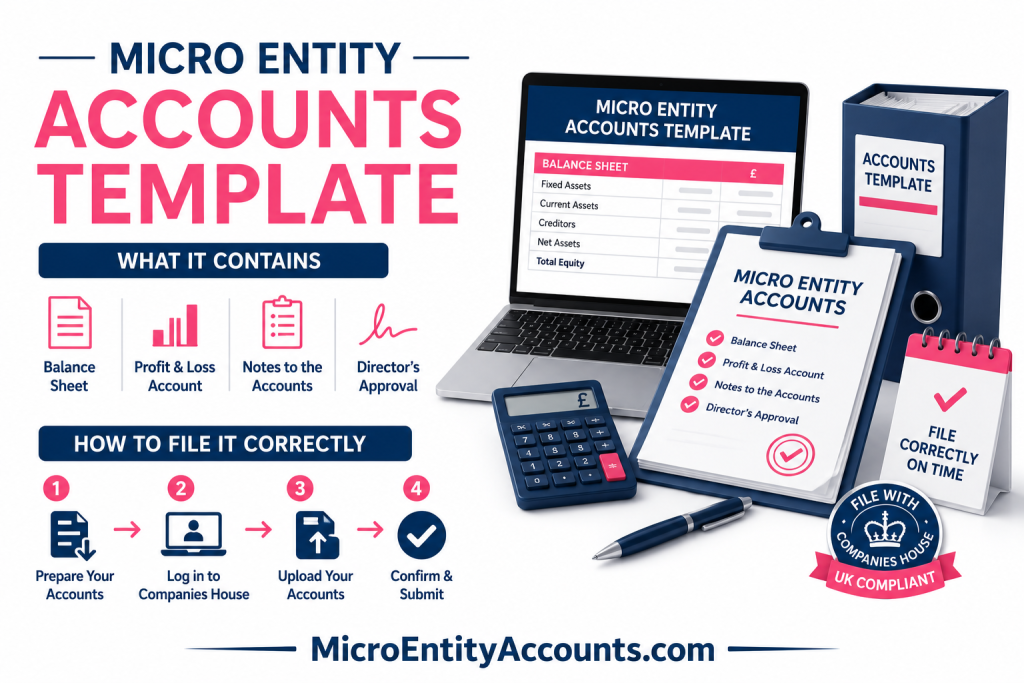
- A balance sheet, this is the only financial statement required on the public record
- The balance sheet must contain the minimum items set out in Schedule 1A of the Small Companies and Groups (Accounts and Directors’ Report) Regulations 2008
- A note about the company’s financial commitments, advances, credits and guarantees given to directors (if any)
- A statement on the balance sheet confirming that the accounts have been prepared in accordance with the micro-entity provisions
You do not need to include a profit and loss account, a directors’ report, or detailed notes to accounts in what you file at Companies House. However, your internal records and HMRC submission should still contain this full information.
Do Micro Entity Accounts Need to Be Audited?
In most cases, no. Companies that qualify as micro entities are also usually exempt from the statutory audit requirement. A company can claim audit exemption if it qualifies as small (which covers micro entities), has a turnover of no more than £15 million, a balance sheet of no more than £7.5 million, and no more than 50 employees. Since micro entities are well below all of these thresholds, they almost always qualify for audit exemption.
That said, there are exceptions. If your company’s articles of association require an audit, or if shareholders holding more than 10% of shares request one, you will still need to have your accounts audited regardless of size.
How Do You File Micro Entity Accounts with Companies House?
You can file micro entity accounts with Companies House in one of two ways:
- Online via the Companies House WebFiling service, this is the quickest and most straightforward option
- By post, using the paper filing forms, though this takes longer and is less common
Most accountants and business owners use the online filing service. You will need your company’s authentication code, which Companies House posts to your registered office address when you first set up the company. If you have lost it, you can request a new one through the Companies House website.
The deadline for filing is nine months after your company’s accounting reference date (your financial year end). Missing this deadline results in automatic penalties, starting at £150 for accounts up to one month late, rising to £1,500 if you are more than six months late.
Important: Even if your accounts are simple, do not leave it to the last minute. A technical issue with the filing portal or a missing document can push you over the deadline and trigger an automatic fine.
What Are the Most Common Mistakes When Filing Micro Entity Accounts?
Based on the queries we see from small business owners, these are the mistakes that come up most often:
- Confusing what you send to Companies House with what you send to HMRC, remember, HMRC needs the full accounts
- Not checking eligibility before assuming you can file as a micro entity, always verify you meet at least two of the three criteria
- Forgetting the director confirmation statement on the balance sheet, the accounts must include a statement confirming they have been prepared under the micro-entity provisions
- Missing the nine-month filing deadline and incurring automatic late filing penalties
- Not updating Companies House if your company grows and no longer qualifies, you must switch to small company accounts if you exceed the thresholds for two consecutive years
Do You Need an Accountant to File Micro Entity Accounts?
You are not legally required to use an accountant to prepare and file micro entity accounts. However, for many small business owners, the peace of mind that comes from having a professional handle it is well worth the cost.
Even if your accounts look simple on the outside, there are details to get right, making sure the balance sheet is correctly laid out, that you have included the required director’s confirmation, that your figures match your bookkeeping records, and that the HMRC submission is consistent with what you have filed at Companies House.
If you are not confident doing this yourself, working with an accountant who specialises in small and micro businesses can save you time, reduce the risk of errors, and give you the confidence that your filings are accurate and on time.
Summary: Key Things to Remember About Micro Entity Accounts
Here is a quick recap of everything covered in this article:
- Micro entity accounts are a simplified filing option for very small UK companies
- To qualify, you must meet at least two of the three thresholds: turnover under £1M, balance sheet under £500,000, or 10 or fewer employees
- You only need to file a basic balance sheet at Companies House, no profit and loss, no directors’ report
- HMRC still requires full accounts alongside your Corporation Tax return
- Most micro entities are also exempt from audit
- The filing deadline is nine months after your financial year end
- If your company grows and stops qualifying, you must switch to small company accounts
If you are unsure whether your company qualifies or you would like help preparing and filing your micro entity accounts, our team is here to help. We work with small business owners across the UK and can take the stress out of your annual accounts — so you can focus on what you do best.
Disclaimer: The content on MicroEntityAccounts is for informational purposes only and do not constitute tax or financial advice. We recommend consulting a certified tax professional or the HM Revenue and Customs Dept (HMRC) for accurate guidance. MicroEntityAccounts is not responsible for any decisions made based on the information provided.