Preparing micro entity accounts does not have to be complicated. If your company qualifies as a micro entity under UK law, you only need to file a simplified balance sheet with Companies House, along with a few basic notes. You do not need to include a profit and loss account or a directors’ report in your public filing. This guide walks you through exactly how to prepare micro entity accounts step by step, in plain language, so you can meet your legal obligations without the confusion.
What Are Micro Entity Accounts?
Micro entity accounts are a simplified version of annual accounts available to the smallest UK limited companies. They were introduced under the Companies Act 2006 (as amended by the Companies, Partnerships and Groups (Accounts and Reports) Regulations 2015) to reduce the administrative burden on very small businesses.
When you prepare micro company accounts, you are essentially putting together a basic snapshot of your company’s financial position at the end of your financial year. Unlike full statutory accounts, micro entity accounts only require a stripped-back balance sheet and a limited set of notes.
The key point is this: less detail goes to the public record at Companies House, but you still need to prepare full internal accounts and a CT600 corporation tax return for HMRC.
Does Your Company Qualify to Prepare Micro Business Accounts?
Before you start preparing anything, you need to confirm your company actually qualifies. To file micro entity accounts, your company must meet at least two of the following three conditions for two consecutive financial years:
- Annual turnover of £1 million or less
- Balance sheet total (total assets) of £500,000 or less
- An average of 10 or fewer employees during the financial year
These thresholds were updated in January 2025 under the Companies Act 2006 (Amendment of Part 15) Regulations 2024. The previous limits were £632,000 turnover and £316,000 balance sheet total, so if you were previously just outside the threshold, it is worth checking again.

Who Cannot Use the Micro Entity Regime?
Even if you meet the size thresholds, some companies are excluded from filing micro entity accounts. These include:
- Public limited companies (PLCs)
- Companies that are part of a group that does not qualify overall
- Limited Liability Partnerships (LLPs)
- Companies regulated under the Financial Services and Markets Act 2000 (such as insurance companies and certain investment firms)
- Charitable companies
If you are unsure whether your company qualifies, it is worth speaking with an accountant before filing.
What Information Do You Need Before You Start?
Getting organised before you start is half the battle. To prepare micro entity accounts, you will need to gather the following information for your financial year:
Financial Records You Need to Collect
- Your bank statements for the full financial year
- Records of all income received (sales invoices, receipts)
- Records of all business expenses paid
- Details of any fixed assets your company owns (equipment, vehicles, computers)
- Details of any money owed to your company (debtors/receivables)
- Details of any money your company owes (creditors/payables, loans)
- Details of director’s loans if any exist
- Share capital information (how many shares are issued and at what value)
If you use bookkeeping software such as Xero, QuickBooks, or FreeAgent, most of this will already be in your system. If you have been keeping manual records or just using spreadsheets, take your time to organise these before proceeding.
How to Prepare Micro Entity Accounts Step by Step
Here is a clear, step-by-step breakdown of how to prepare micro company accounts that comply with Companies House and HMRC requirements.
Step 1: Confirm Your Financial Year End
Your company’s financial year end (also called the accounting reference date) is the date at which you prepare your accounts. For most companies, this is 31 March or 31 December, but it can be any date. You can find your accounting reference date on Companies House WebFiling or on your confirmation statement.
Your annual accounts must be filed with Companies House within 9 months of your financial year end. So if your year ends on 31 March, your filing deadline is 31 December of the same year.
Step 2: Prepare Your Profit and Loss Account (For Internal Use)
Even though you do not file a profit and loss account (P&L) with Companies House as a micro entity, you still need to prepare one for internal purposes and for your corporation tax return.
Your P&L account should show:
- Total income or turnover for the year
- Cost of sales (if applicable)
- Gross profit
- All business expenses (rent, wages, insurance, software, professional fees, etc.)
- Net profit or net loss for the year
This figure flows into your CT600 corporation tax return, which you must file with HMRC separately.
Step 3: Prepare Your Balance Sheet
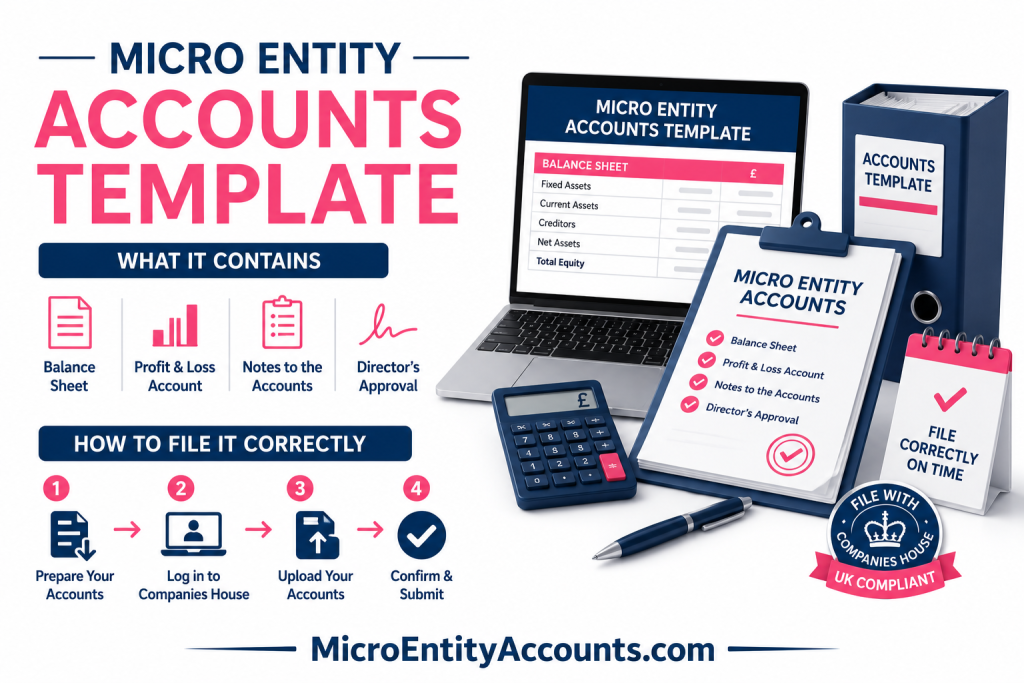
The balance sheet is the core of your micro entity accounts and the document you actually file with Companies House. It shows your company’s financial position on the last day of your financial year.
A micro entity balance sheet is structured around three key sections:
- Fixed Assets: These are assets your company owns for the long term, such as equipment, machinery, or vehicles. They are listed at their net book value (original cost minus accumulated depreciation).
- Current Assets: These are assets that are expected to convert to cash within 12 months. This includes debtors (money owed to you), stock or inventory, prepayments, and cash in the bank.
- Creditors: These are split into amounts falling due within one year (short-term liabilities) and amounts falling due after more than one year (long-term liabilities). This includes trade creditors, bank loans, VAT owed, PAYE owed, and director’s loan accounts if the company owes money to a director.
The balance sheet must balance, meaning your total assets minus your total liabilities must equal your total equity (also called net assets or shareholders’ funds).
The equity section includes:
- Called-up share capital (the value of shares issued)
- Share premium (if shares were issued above their nominal value)
- Profit and loss reserve (accumulated retained profits or losses)
Step 4: Add the Required Notes to Your Accounts
Micro entity accounts still require a small number of mandatory notes. You cannot skip these even though the accounts are simplified. The required disclosures include:
- Accounting policies: A brief statement confirming the basis on which you have prepared the accounts (for example, whether you use the accruals basis or cash basis, and how you calculate depreciation)
- Advances, credits, and guarantees given to directors, If any director has received a loan from the company or the company has provided a guarantee on behalf of a director, this must be disclosed
- Share capital, The number and class of shares issued, along with their nominal value
You do not need to include information about employee numbers, off-balance sheet arrangements, or a directors’ report in the public filing. This is one of the main privacy benefits of the micro entity regime.
Step 5: Apply the Correct Accounting Policies
Accounting policies are the rules you use to record and present your financial information. For micro entities, the relevant standard is FRS 105 (Financial Reporting Standard applicable to the Micro-entities Regime).
Key points under FRS 105 include:
- Assets must be measured at historical cost — you cannot revalue assets upwards
- Deferred tax is not recognised
- Financial instruments are measured at transaction price (no fair value adjustments)
- There is no requirement to separately present exceptional items
FRS 105 is simpler than FRS 102 (used by small companies) and is designed specifically for micro entities. If your company has complex transactions such as foreign currency contracts, share options, or pension schemes, FRS 105 may not be appropriate and you should consider whether a different reporting standard is needed.
Step 6: Prepare Your Corporation Tax Return (CT600)
Alongside your annual accounts, you must file a Corporation Tax Return (CT600) with HMRC. This is due within 12 months of your financial year end, though the tax itself must be paid within 9 months and one day of the year end.
The CT600 is based on your profit and loss account. You start with your accounting profit, then make adjustments for:
- Expenses not allowable for tax purposes (such as client entertainment or fines)
- Capital allowances (which replace the depreciation charge in your accounts)
- Any losses brought forward from previous years
The resulting figure is your taxable profit, and corporation tax is charged at the applicable rate. From April 2023, the main rate is 25% for profits above £250,000, with a small profits rate of 19% for profits up to £50,000, and marginal relief for profits in between.
Step 7: File Your Accounts with Companies House
Once your accounts are prepared and reviewed, you need to file them with Companies House. You have two options:
- Online filing via Companies House WebFiling (free and the fastest method)
- Filing through third-party accounting software or via your accountant
To file online, you will need your company’s authentication code, which Companies House sends by post when your company is first incorporated. If you have lost it, you can request a new one through the Companies House website.
The accounts must be approved and signed by a director before filing. When filing micro entity accounts, you will confirm that you are taking advantage of the micro entity exemptions.
Your filing deadline is 9 months after your financial year end. Missing this deadline results in an automatic financial penalty, which increases the longer you leave it:
- Up to 1 month late: £150
- 1 to 3 months late: £375
- 3 to 6 months late: £750
- More than 6 months late: £1,500
These penalties double if your company files late in two consecutive years.
What Is the Difference Between Filing with Companies House and HMRC?
This is a common point of confusion for many business owners. Here is a simple breakdown:
- Companies House receives your annual accounts (the balance sheet and notes). This information becomes part of the public record and anyone can view it.
- HMRC receives your CT600 corporation tax return along with your full accounts (including the profit and loss account). This information is not public.
Both submissions are separate and have different deadlines. Failing to file either can result in penalties, so it is important to keep track of both.

Can You Prepare Micro Entity Accounts Yourself?
Legally, yes. There is no requirement for a micro entity to use a qualified accountant. Companies House accepts self-prepared accounts as long as they meet the legal requirements.
However, there are a few things to consider before going it alone:
When Preparing Them Yourself Might Work
- Your business has very simple finances with minimal transactions
- You have a basic understanding of bookkeeping and accounting
- You have access to accounting software that can generate compliant accounts
- You have the time to learn what is required and keep up with any rule changes
When Using an Accountant Makes More Sense
- You have never prepared accounts before and are unsure where to start
- Your business has more complex transactions such as loans, asset purchases, or VAT
- You want to make sure your CT600 is accurate and your tax liability is correct
- You want someone to deal with HMRC on your behalf if there are any queries
- You want peace of mind that deadlines are met and penalties are avoided
For many micro business owners, the cost of using an accountant is often offset by the time saved, mistakes avoided, and the confidence of knowing everything has been done correctly.
What Are the Common Mistakes to Avoid When Preparing Micro Entity Accounts?
Even with simplified accounts, there are a few common errors that can cause problems. Being aware of these can save you a lot of stress.
Mixing Up Personal and Business Finances
If you have been using your personal bank account for business transactions, you will need to untangle these before you can prepare accurate accounts. Going forward, always keep a separate business bank account. This makes bookkeeping significantly easier and avoids complications with HMRC.
Forgetting to Record All Assets and Liabilities
A common oversight is failing to include all assets your company owns or all amounts it owes. For example, if you purchased a laptop for the business two years ago, it should still appear on your balance sheet as a fixed asset (at its depreciated value) unless it has been fully written off.
Getting the Director’s Loan Account Wrong
If you have taken money out of the company for personal use beyond your salary and declared dividends, this may be recorded as a director’s loan. If the company owes you money, this appears as a creditor. If you owe the company money, it appears as a debtor. Getting this wrong can lead to unexpected tax consequences, including a Corporation Tax charge of 33.75% on outstanding loans owed to the company by participators (Section 455 tax).
Missing the Filing Deadline
It sounds simple, but many business owners forget their filing deadline, especially if their financial year end is in a quiet period. Diarise your deadlines well in advance. Your Companies House deadline is 9 months after your year end, and your HMRC CT600 deadline is 12 months after your year end. Your corporation tax payment is due 9 months and 1 day after your year end.
Claiming Expenses That Are Not Allowable
Some expenses appear in your accounts but are not deductible for tax purposes. Client entertaining is a well-known example. Fines and penalties are another. If you include non-allowable expenses in your CT600 without making the correct adjustments, you may underpay tax, which HMRC can investigate and penalise.
How Long Should You Keep Your Micro Entity Accounting Records?
Under UK law, private limited companies must keep accounting records for at least 6 years from the end of the financial year they relate to. This includes:
- Bank statements
- Sales invoices and receipts
- Purchase invoices and receipts
- Payroll records
- VAT records (if you are VAT registered)
- Copies of accounts and tax returns filed
HMRC can open an enquiry into your tax return up to 12 months after the filing deadline in normal circumstances, or up to 4 years if there has been a careless error, or up to 20 years if HMRC suspects deliberate non-compliance. Keeping records for at least 6 years gives you a solid safety buffer.
What Happens After You File Your Micro Entity Accounts?
Once you have successfully filed with both Companies House and HMRC, you should receive confirmation from both. Companies House will update the public register with your filing and confirm acceptance. HMRC will process your CT600 and calculate any tax due based on your return.
If you have a tax liability, you need to pay it by the payment deadline. You can pay HMRC online through your business tax account.
If you cannot afford to pay in full, you can contact HMRC to arrange a Time to Pay arrangement, though it is always best to contact them before the deadline rather than after.
After filing, it is a good time to start gathering records for your next financial year. Good bookkeeping throughout the year makes account preparation significantly less stressful the next time around.
Do You Need to File a Confirmation Statement as Well?
Yes. The confirmation statement (previously called the annual return) is separate from your annual accounts and must also be filed with Companies House every year.
The deadline is within 14 days of your confirmation statement review date, which is usually the anniversary of your company’s incorporation.
The confirmation statement confirms that the information Companies House holds about your company is accurate, including details of directors, registered office, and shareholders. It does not include financial information.
There is currently a £34 filing fee for the confirmation statement if filed online (as of 2025). Failing to file it can lead to your company being struck off the register.
Summary: Key Steps to Prepare Micro Entity Accounts
Here is a quick recap of the entire process:
- Confirm your company qualifies as a micro entity (meets at least 2 of the 3 size criteria for 2 consecutive years)
- Gather all financial records for the year including bank statements, invoices, and asset details
- Prepare your internal profit and loss account (not filed publicly but needed for the CT600)
- Prepare your balance sheet showing fixed assets, current assets, creditors, and equity
- Add the required notes including accounting policies and any director’s loans or guarantees
- Apply the FRS 105 accounting standard correctly
- Prepare and submit your CT600 corporation tax return to HMRC
- File your micro entity accounts with Companies House before the 9-month deadline
- Keep all supporting records for at least 6 years
Preparing micro entity accounts is manageable once you understand what is required. The key is staying organised throughout the year, knowing your deadlines, and making sure both your Companies House and HMRC filings are complete and accurate. If at any point you feel out of your depth, working with a specialist accountant is often the most cost-effective decision you can make for your business.
Need help preparing your micro entity accounts? At MicroEntityAccounts.com, we handle everything from preparation to filing for a fixed fee of £399 + VAT. No surprises, no hidden costs. Get in touch today.
Disclaimer: The content on MicroEntityAccounts is for informational purposes only and do not constitute tax or financial advice. We recommend consulting a certified tax professional or the HM Revenue and Customs Dept (HMRC) for accurate guidance. MicroEntityAccounts is not responsible for any decisions made based on the information provided.